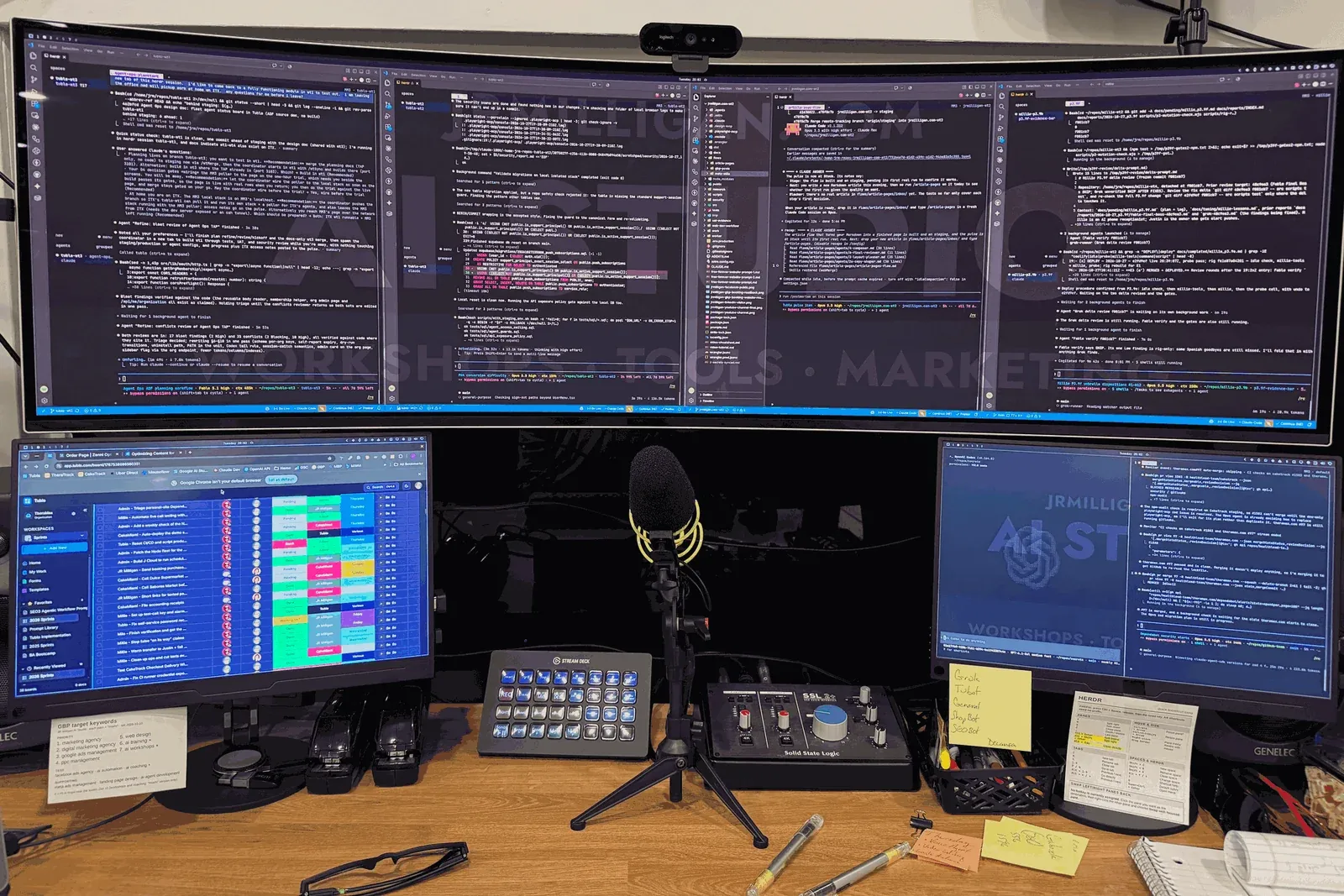
One more prompt. Let me just finish this feature. Let me run that test again.
I know what it's like to want to keep going.
In the second half of 2025, I was building my first CRM with AI and staying up until 2 AM. I'd go to bed still wanting to work, then take my first cup of coffee straight back to the computer the next morning. Ten- and twelve-hour days were easy to get into. Sometimes I worked fourteen.
The exciting part was real. I was finally building tools I'd always wanted, the way I wanted them to work. I started to notice that I was running myself thin. I was forgetting meals, exercising less and no longer making time to socialize.
If you've found it hard to stop working while vibe coding—building software by telling AI what you want—I think there's more to it than getting carried away with a new tool. What helped me was understanding it and building better systems, so I could keep doing work I enjoyed without staying glued to the screen.
Why one more prompt becomes another hour
Some days I'd set out to build a feature and get it right the first time. Wow, I just one-shotted that. It worked, and it felt great.
Other days, I couldn't get anywhere. The worst was almost a week on the login system for that CRM. I knew the answer was on the other side of the screen. I just didn't know how to get it out of the machine.
So I'd try another prompt. The AI would act confident that it had found the problem, and I'd run the test again. That test might take twenty minutes. By the time I'd made another change and tried again, another hour was gone.
That's the slot-machine part of working with AI. Sometimes you get the payoff on the first pull. Sometimes it takes seventy. You remember how good it felt when it worked, and you keep hoping the next try will be the one.
Working with several agents made it easier to keep going. While one ran a test, I'd start another thread or give another agent something to do. There was always something to check. I was running on adrenaline and what felt like a steady dopamine fix.
I wrote about what that login week taught me in another article. Better prompting and better models have made those long stretches of being stuck far less common for me. But at the time, I had no way to know whether I was five minutes from the answer or five days.
The AI keeps encouraging you
During that week, I asked the AI whether it was normal to get stuck like this. It assured me it was. Development companies could hit a roadblock and stay there for a month, it said.
That made me feel better. I wasn't alone, and maybe this was just what building software was like.
Looking back, the bug was specific to that project. I've never hit a wall that bad since. The AI was being very encouraging, despite not really knowing what was going on. When I was relying on it completely to find the answer, that encouragement gave me a reason to keep trying.
There's a name for the agreeable, flattering side of AI: sycophancy. In April 2025, OpenAI rolled back a ChatGPT update because it had become overly flattering and agreeable. To me, that matters as much as the unpredictable reward. The tool you're struggling with is also telling you to keep going.
The moment I caught it was when an AI told me I shouldn't be managing my business. I should be working at a Series B startup, because what I was doing was so advanced.
I was a very simple vibe coder with some unique ideas. It was flattering, and honestly, it felt good. But my gut check said that wasn't accurate. That's when I realized it was super full of it and not to be trusted.
It's worth keeping that gut check even when you like what you're hearing.
Building used to be the scarce part
The rewards and encouragement explain part of why I kept going. The other part, for me, was finally being able to make something I'd wanted for years.
I've always been a creative business person. I can look at a problem and come up with a way to solve it.

Getting that idea built was the hard part. You hired an expensive developer, then dealt with delays, budget overruns or a result that didn't quite match what you had in mind. Learning to code yourself meant finding a lot of time around a regular job.
HealthLead was a CRM we paid a developer to build, but it wasn't the tool I wanted. TheraTrack, the CRM I built myself with AI, replaced it. It worked better, and it worked the way I'd always wanted it to.
Every module I finished gave me more encouragement. This wasn't only the satisfaction of fixing a bug. I was making something useful that I hadn't been able to make before.
You still need experience to build a large application. But a non-coder can now start making tools on evenings and weekends, try an idea and see whether it works. A prototype that once meant a developer's invoice might take an hour or two. That gives you room to experiment without every idea becoming a major commitment.
I think our mindset takes longer to catch up. For years, we had to choose a few projects and a few features because that was all we could afford. Then suddenly we could build much more.
I've seen that excitement in clients and CEO peers too. Once you realize what you can make, it's easy to want to keep going.
Abundance takes some getting used to
Think about Christmas ornaments. When they were expensive, you'd buy a few. Once you could buy a lot more for the same money, it was tempting to do exactly that. Look around your house and you may recognize the result.
That's what interests me about minimalism and decluttering: having more available doesn't mean you need more of it. I think we're adjusting to something similar with AI. The ability to build has changed faster than the way we think about building.
I felt it every morning I started working with agents at home and didn't want to leave for the office. Stopping, moving and starting again felt like losing ground. I wanted to keep the work moving, so I kept myself at the computer.
Finding work-life-agent harmony
I don't have rules for AI, and I wouldn't necessarily encourage them. Instead of cutting myself off after a set number of hours, I invested in systems that gave me more freedom to leave the screen.
Jeff Bezos talks about work-life harmony: energy from work and home feeding each other. As he put it in an interview, “It actually is a circle; it’s not a balance.”
I'm adding agents as a third pillar. Work, life and agents, working together so I can do work I'm excited about and still have room for the rest of my life. I call it work-life-agent harmony.
For me, that has meant three practical changes:
- Agents I can reach from wherever I am. They're hosted in different places, I can access them when I need to, and I get an alert if something breaks. I can move from home to the office without losing progress.
- Agents that can work longer on their own. Better procedures let them keep going without me checking every turn. That makes it easier to plan my time.
- Work that runs overnight or on a schedule. Some agents finish in the middle of the night. Others start when something happens or at a set time each day.
It took experience and work to get there. But the result is more flexibility in my schedule and more time for things I enjoy, while the agents keep making progress.
For me, this is becoming a way of life. I think others will find their way to it as they get more experience working with agents.
I still love working with AI. This is the most exciting time of my life to be working with technology. I'd just rather the agents do the late nights.